Monday, May 31, 2010

Thoughts on Memorial Day 2010


Decoration Day Parades in the 1940s

My grand uncle Bill was alive when I was a boy. He was my paternal grandfather’s brother. My father was named after him, as was my brother after my father. I remember grand uncle Bill reasonably well. (We called him “Uncle Bill”.)

He lived with my grandfather’s family -- a bachelor brother taken in somewhere along the way and watched over. His immediate family called him “Tootoo” because he occasionally went on “toots”, which was a word used for binges in those days. He drank infrequently, but when he did, the bout lasted for days.

Uncle Bill was usually unshaven, smelled of cigarettes, and often sat in a corner in a chair and complained about ill behaved children. However, like so many older forgotten men, he had a past. And that past was linked with Cuba. Uncle Bill was a Spanish American War veteran, a distant war even then. And I know virtually nothing of what he had done in that conflict.

I was a boy during World War II and lived in an apartment house one half block from the Grand Concourse in the Bronx, the borough’s major north-south artery. I was aged seven when the war began and ten when it ended. Living near the Concourse had one advantage: a proximity to its parades. And by far the best Bronx parade at that time was the rather large Decoration Day Parade, as it was then so called. The war had increased the parade’s size and significance I am sure. This was the early 1940s, our nation was at peril and the military was revered.

I remember those parades vividly and the excitement when we first heard the music from far away marching bands working their way up from the south Bronx on their way to the Veterans Hospital some forty blocks north. I remember that far away music hastening my pace to reach a place from which to watch the spectacle.

And I have a distinct memory of Uncle Bill marching with a small group of what seemed like very old men up the Grand Concourse in the Decoration Day Parade. The men were what remained of a small local group of Spanish American War veterans. They wore suits, I think, with appropriate medals pinned on and some sort of quasi-military headgear –- perhaps American Legion hats. And as Uncle Bill marched, he was far removed from the tired old man who sat in the corner for the rest of the year.

One might reflect on Uncle Bill walking with those men while another war was going on. They might have been remembering parades gone by. As now, I remember parades gone by. And Uncle Bill had a tale to tell I am sure, but it was not told to me or to anyone else of which I am aware. So time has washed away his story as the years have washed away Decoration Day and renamed it Memorial Day. And the size of, and the enthusiasm for, such parades -- in too many places, alas, has diminished.


A note on the photograph:

The photograph is from Flickr and is listed as “1940s - The Bronx, Grand Concourse, 4th of July Parade”, submitted by Straatis. But neither my wife nor I remember such a Bronx parade in 1940s. I suspect the photograph might be that of a Decoration Day Parade. (Google Maps shows us that the location is 169th Street.)

Sunday, May 30, 2010

Words and Images 34


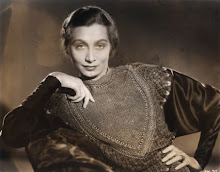
Katharine Hepburn quoted in The House of Barrymore by Margot Peters

Thursday, May 27, 2010

Short Cuts 5: A good part and a simple question


Michael Powell has said that there is no such thing as a small part in a film. There are good parts and bad. Never was there a better manifestation than Harriet Bird in The Natural: a special part about a woman who asks a simple question. “Will you be the best there ever was in the game?”

The Natural is a film about baseball as myth. It centers on Roy Hobbs, a baseball phenom destined to be the best there ever was. But Roy first has to undergo a series of forging fires. And Harriet Bird provides the first of those conflagrations.


Barbara Hershey plays Harriet with the stillness of Mrs. Danvers and the quiet destructive manner of Julie Kohler. Harriet is a modern day demented Morgan le Fay, perhaps. She brings down lords of lesser fiefdoms. (We learn offhandedly that she has, off camera, stalked the greatest in sports other than baseball and killed them with a silver bullet.)

Sexy temptress? One understands why Scorsese chose Barbara Hershey to play Mary Magdalene.

Harriet Bird is on a train stalking The Whammer, the essence of Babe Ruth, and currently believed to be the best there is. Roy Hobbs is also on the train. An old baseball hand introduces the reigning lord and the lowly aspirant. Later, while the train is at rest at a water stop, an argument ends in a test of manliness at a fairground. The age old baseball showdown takes place: pitcher vs. hitter (Sir Lancelot vs. Sir Turquine). Three pitches will decide all.

The superstar, The Whammer, strikes out on three pitches. Harriet Bird witnesses the sandlot strikeout and with a turn of a glance moves an unpublished death notice from major league superstar to promising phenom. Roy Hobbs becomes a hero, having taken the first symbolic step toward being the best there ever was.

Harriett watches as Roy does that little skip of joy not realizing he has half danced his way into sixteen years of ignominy. The chilling Miss Bird’s eye has shifted now from second best to first. To ensure her quest is on target, she later meets Roy on the train and asks him that question. “Will you be the best there ever was in the game?” Roy affirms.


Next -- a scene in a hotel. Roy is called to another room. Harriet, like some celestial messenger in a mourning dress and veil, asks the fateful question once more. Roy assures her – once more. A gunshot. Roy lays bleeding on the floor. A curtain rustles by an open window. The angel of death was without wings. Roy Hobbs is without a career.

The film in essence begins but its very best part is behind us.

Tuesday, May 25, 2010

Jazz Boat: a face on the cutting room floor


Jazz Boat sailed without me. In 1959, circumstances led me to London and consequently to believe that I might have made a brief appearance in a crowd scene in the 1960 Anthony Newley film. Part of Jazz Boat was filmed on the south bank of the Thames. I searched for the film for fifty years but to no avail.

I eventually told the story this year in a February posting called My Film Career (Offstage). Enter the good Matthew Coniam (Movietone News) of London, who read the posting, told me he had a copy of Jazz Boat, and sent a Region 2 DVD copy to me. (I have thanked him separately, and do so here again.)

In late spring of 2010, circumstances again led me to London and provided me the where-with-all to play the DVD. Came the scene, came the one frame at a time, step by step, came the dawning. A lifetime of watching films, with nary an appearance within one, remained unsullied. Jazz Boat sailed without me.

I informed Matthew, who, not surprisingly, summed up my absence perfectly. He told me in a comment:

“So sorry your fifty year quest for Jazz Boat ended up with the disappointing view of the underside of the editor's table from the vantage of the cutting room floor, but hopefully the scene itself brought back some memories, and remember that the camera does not catch all, merely that which fate casts within its four walls - you are still 'there', even if the lens is not sharp enough to spot you.”

Who could add to that?